
Lanzan proyecto inédito para disminuir consumo de antibióticos en la salmonicultura chilena
Publicado el: 21 marzo 2024

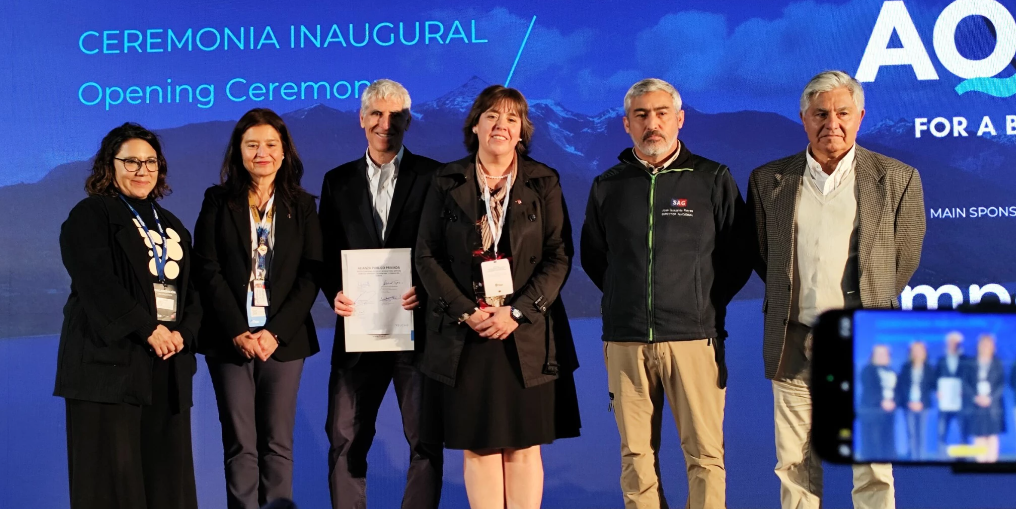
En la ceremonia inaugural de AquaSur, se concretó una alianza público privada, que comprende el trabajo conjunto de productoras, gremios, servicios públicos, farmacéuticas y proveedores contra SRS. 

Y llegó el día en que AquaSur abrió sus puertas. La versión Nº12 de la feria acuícola más importante del hemisferio sur, dio el vamos a tres días de exposición, reuniendo a profesionales, tomadores de decisión y empresas líderes de la industria, que se han reunido para conocer las últimas tecnologías e innovaciones en Terminales Marítimos de la Patagonia.

En la ceremonia inaugural de AquaSur 2024, Francisco Sotomayor, director Ejecutivo de GL events Group Chile, destacó la realización del “evento acuícola que el sector se merece siendo el segundo más importante a nivel mundial. Este año, AquaSur cumple 25 años de vida y en esta larga trayectoria, nuestra vocación ha sido siempre la de unir y conectar a todos los actores del mundo acuícola. Damos hoy lugar a una versión sin precedentes, con más de 480 expositores provenientes de 20 países que representan más de 1.800 marcas, con un 100% de crecimiento respecto a lo que fue AquaSur 2022, más de 16 mil m2 de exhibición y una cantidad de visitantes que superaron en un 70% la versión anterior. Esto es un buen augurio de lo que será esta instancia en términos de convocatoria”.

Por su parte, Arturo Clément, presidente de SalmonChile relevó el aporte de la salmonicultura en el desarrollo del sur del país y dio cuenta del trabajo realizado por el gremio y sus empresas socias para avanzar en diversas áreas, como en materias laborales y sociales. Además, indicó que la actividad vive años de permanente incertidumbre, por una evidente pérdida de competitividad.

“Razones de esto puede haber muchas, pero es evidente que el no contar con una visión país respecto a la acuicultura y salmonicultura del futuro le ha hecho un grave daño a las certezas y proyecciones del sector, así como a las regiones donde operamos”, señaló el directivo.

Asimismo, Clément puntualizó que las regulaciones futuras de este sector “deben tramitarse de manera abierta y transparente, sobre la base de un diálogo amplio, que integre las distintas miradas de quienes participan en esta actividad, de cara, también, a las comunidades y habitantes de las regiones donde operamos, y tomando en cuenta criterios científicos para que gocen de una amplia legitimidad en todo su proceso. Si queremos que esta actividad siga aportando al país en los años venideros, tal como lo ha hecho hasta ahora, debemos pensar en políticas públicas de largo aliento, que permitan su desarrollo sustentable, con un crecimiento responsable y sostenible, de manera tal que la salmonicultura siga aportando y promoviendo el bienestar del sur austral del país”.

En esta línea, el subsecretario de Pesca y Acuicultura, Julio Salas, resaltó a AquaSur como un lugar de encuentro muy significativo para todo el sector acuícola y la cadena de producción asociada al sector.

“Como Gobierno, estamos convencidos que la clave para el desarrollo acuícola en Chile es que se incremente la legitimidad social de la acuicultura y específicamente de la salmonicultura. Esta legitimidad social de la salmonicultura a la opinión que las comunidades tienen sobre el desarrollo de la actividad, entendiendo a las comunidades como los trabajadores y sus familias, pero también el entorno que se ve impactado por las externalidades que genera la actividad. Por ello, todo esfuerzo de sustentabilidad es, finalmente, una inversión bien realizada para la sostenibilidad a largo plazo de la actividad salmonicultora”, precisó el Subsecretario.

En relación al desarrollo de la propuesta de una nueva Ley General de Acuicultura, Salas comentó que durante el último trimestre del año pasado se iniciaron las conversaciones con los diferentes actores y representantes de la acuicultura chilena. “Cumplimos con ese compromiso. Con la Universidad de Valparaíso realizamos cerca de 40 encuentros con la acuicultura de pequeña escala, realizamos un primer seminario con el sector mitilicultor y desarrollamos una mesa de trabajo con el sector salmonicultor. Lo que viene ahora es la continuidad de ese trabajo, desde abril en adelante, y creemos que tardaremos a los menos seis meses poder recopilar y escuchar la opinión de todos los sectores, para luego elaborar la propuesta. Por lo tanto, esperamos presentarle al país una Ley General de Acuicultura durante el primer semestre de 2025”.

Proyecto Yelcho 

Enmarcado bajo el nombre de “Proyecto Yelcho”, 11 empresas productoras de salmón, en conjunto con el Consejo del Salmón, Intesal de SalmonChile y con el apoyo de Aquabench, propusieron durante el año 2023 al Servicio Agrícola y Ganadero (SAG) y al Servicio Nacional de Pesca y Acuicultura (Sernapesca) trabajar colaborativamente en una alianza que permita avanzar efectivamente en la implementación de nuevas soluciones para prevenir enfermedades bacterianas como SRS y reducir el uso de antibióticos.

Fue así como estas entidades, en la ceremonia inaugural de AquaSur 2024, firmaron esta alianza público-privada, que se enfocará en cuatro áreas específicas: evaluar el desarrollo de nuevas tecnologías inmunológicas; evaluar el uso de herramientas prolongadoras de la inmunidad de los peces; facilitar el acceso y desarrollo de información técnica que permita avanzar de forma más rápida para obtener nuevas vacunas y/o productos inmunológicos; y generar instancias de colaboración continua entre autoridad y sector privado, como seminarios y jornadas técnicas de trabajo.

“Yelcho nace de una necesidad de la industria salmonicultora y del Estado de buscar formas para disminuir el uso de antibióticos en Chile, alineados con los objetivos de la Organización Mundial de la Salud que busca fórmulas para combatir la resistencia a los antimicrobianos. En este contexto, las empresas productoras hicieron una invitación a las empresas farmacéuticas y al Estado para trabajar en forma conjunta y con objetivos muy definidos, para buscar soluciones de manera pragmática, inspirados en el trabajo que hizo nuestro país en la estrategia contra el Covid 19”, manifestó David Farcas, director del Proyecto Yelcho.

Los próximos pasos de esta alianza son la definición de una agenda de reuniones de trabajo de un Comité Técnico-Científico el cual estará integrado por un equipo multidisciplinario de científicos de alto renombre, como el Dr. Alexis Kalergis, jefes de Salud de las empresas productoras y de las contrapartes técnicas de SAG y Sernapesca.

Tras esta alianza están las empresas AquaChile, Australis Seafoods, Blumar, Salmones Camanchaca, Cermaq, Cultivos Yadran, Marine Farm, Mowi, Multi X, Salmones Austral, Ventisqueros y Aquabench, que significan casi el 90% de la producción de salmón Atlántico en Chile.

Fuente: www.salmonexpert.cl

Lanzan proyecto inédito para disminuir consumo de antibióticos en la salmonicultura chilena
Publicado el: 21 marzo 2024

At the opening ceremony of AquaSur, a public-private alliance was established, which includes the joint work of producers, unions, public services, pharmaceutical companies and suppliers against SRS.

And the day arrived when AquaSur opened its doors. The 12th version of the most important aquaculture fair in the southern hemisphere, gave way to three days of exhibition, bringing together professionals, decision makers and leading companies in the industry, who have gathered to learn about the latest technologies and innovations in Maritime Terminals from Patagonia.

At the opening ceremony of AquaSur 2024, Francisco Sotomayor, Executive Director of GL events Group Chile, highlighted the holding of the “aquaculture event that the sector deserves, being the second most important in the world. This year, AquaSur celebrates 25 years of life and in this long history, our vocation has always been to unite and connect all the actors in the aquaculture world. Today we are giving rise to an unprecedented version, with more than 480 exhibitors from 20 countries representing more than 1,800 brands, with 100% growth compared to what was AquaSur 2022, more than 16 thousand m2 of exhibition and a number of visitors that exceeded the previous version by 70%. “This bodes well for what this event will be like in terms of attendance.”

For his part, Arturo Clément, president of SalmonChile, highlighted the contribution of salmon farming to the development of the south of the country and gave an account of the work carried out by the union and its member companies to advance in various areas, such as labor and social matters. Furthermore, he indicated that the activity is experiencing years of permanent uncertainty, due to an evident loss of competitiveness.

“There may be many reasons for this, but it is evident that not having a country vision regarding aquaculture and salmon farming of the future has done serious damage to the certainties and projections of the sector, as well as to the regions where we operate,” the manager pointed out.

Likewise, Clément pointed out that the future regulations of this sector “must be processed in an open and transparent manner, on the basis of a broad dialogue, which integrates the different perspectives of those who participate in this activity, also facing the communities and inhabitants. of the regions where we operate, and taking into account scientific criteria so that they enjoy broad legitimacy throughout their process. If we want this activity to continue contributing to the country in the coming years, just as it has done until now, we must think about long-term public policies that allow its sustainable development, with responsible and sustainable growth, in such a way that salmon farming «continue to contribute and promote the well-being of the southern south of the country.»

Along these lines, the Undersecretary of Fisheries and Aquaculture, Julio Salas, highlighted AquaSur as a very significant meeting place for the entireaquaculture sector and the production chain associated with the sector.
“As a Government, we are convinced that the key to aquaculture development in Chile is to increase the social legitimacy of aquaculture and specifically salmon farming. This social legitimacy of salmon farming is linked to the opinion that the communities have about the development of the activity, understanding the communities as the workers and their families, but also the environment that is impacted by the externalities generated by the activity. Therefore, every sustainability effort is, ultimately, a well-made investment for the long-term sustainability of salmon farming activity,” said the Undersecretary.
In relation to the development of the proposal for a new General Aquaculture Law, Salas commented that during the last quarter of last year, conversations began with the different actors and representatives of Chilean aquaculture. “We fulfilled that commitment. With the University of Valparaíso we held nearly 40 meetings with small-scale aquaculture, we held a first seminar with the mussel farming sector and we developed a working group with the salmon farming sector. What is coming now is the continuity of this work, from April onwards, and we believe that it will take at least six months to collect and listen to the opinion of all sectors, and then prepare the proposal. Therefore, we hope to present a General Aquaculture Law to the country during the first half of 2025.”

Yelcho Project

Framed under the name “Yelcho Project”, 11 salmon producing companies, together with the Salmon Council, Intesal of SalmonChile and with the support of Aquabench, proposed during the year 2023 to the Agricultural and Livestock Service (SAG) and the Service National Fisheries and Aquaculture (Sernapesca) work collaboratively in an alliance that allows effective progress in the implementation of new solutions to prevent bacterial diseases such as SRS and reduce the use of antibiotics.This is how these entities, at the opening ceremony of AquaSur 2024, signed this public-private alliance, which will focus on four specific areas: evaluating the development of new immunological technologies; evaluate the use of tools that prolong fish immunity; facilitate access and development of technical information that allows for more rapid progress in obtaining new vaccines and/or immunological products; and generate instances of continuous collaboration between authorities and the private sector, such as seminars and technical work days.

“Yelcho was born from a need for the salmon farming industry and the State to look for ways to reduce the use of antibiotics in Chile, aligned with the objectives of the World Health Organization that seeks formulas to combat antimicrobial resistance. In this context, the manufacturing companies invited pharmaceutical companies and the State to work together and with very defined objectives, to seek solutions in a pragmatic manner, inspired by the work our country did in the strategy against Covid 19. ”said David Farcas, director of the Yelcho Project.

The next steps of this alliance are the definition of an agenda of work meetings of a Technical-Scientific Committee which will be made up of a multidisciplinary team of highly renowned scientists, such as Dr. Alexis Kalergis, heads of Health of the producing companies. and the technical counterparts of SAG and Sernapesca.Behind this alliance are the companies AquaChile, Australis Seafoods, Blumar, Salmones Camanchaca, Cermaq, Cultivos Yadran, Marine Farm, Mowi, Multi X, Salmones Austral, Ventisqueros and Aquabench, which account for almost 90% of Atlantic salmon production in Chile.

Source: www.salmonexpert.cl


Ir a Arriba